Sunday, 8 August 2010

Saturday, 7 August 2010
GAMBLING IS STUPID

Over a friendly game of cards last night, some friends of mine and I had a discussion about whether or not No Limit Texas Hold 'Em really counts as gambling. We decided it didn't; it's only a game of chance in the sense that everything in life is as well. True, occasionally you'll get fucked over by the wrong card hitting the board, just like occasionally meteors fall out of the sky and destroy 90% of the organic life on Earth, but hey, shit happens. If you can exert rational control over a game, it's not gambling, and ultimately what you're doing is betting on skill.
This, of course, is why betting on sports is one of the dumbest fucking things imaginable. As a fan, you have no rational control. You can collect all the information you want about West Ham's second-string goalkeeper starting the next match because Robert Green was assassinated (hypothetical, but English people are displeased with that cat), about a point guard not having any cartilage in his knee anymore and his team, ergo, not being as good anymore, or about a star pitcher missing his next start and some dork from the bullpen going instead. You can analyze historical trends about this team beating that team, this player deviating from the mean consistently against this other player, all the livelong day. In the end, no one has any fucking idea what's actually going to happen. Except the players themselves.
Gambling in sports goes back as far as sports do. I'm sure, in Ancient Greece, some shady lookin' dude in a silk toga was giving odds on which naked guy could throw discuses the farthest, Roman shylocks (moar like Venetian Shylocks, amirite?) would give you 2/1 on an over/under of three Christians eaten by the lions, and so forth. But no supposition is necessary when looking back at gambling in the 1910s in baseball. It was an institution.
One of the game's most talented players in the 'teens, a first baseman named Hal Chase, was banned from the game for taking money from gamblers to lose on purpose. And, of course, 70-odd years later, the man with more hits than anyone else in the history of the game, Pete Rose, was banned for life for gambling on baseball. However, neither of these were the most infamous gambling scandal in baseball history. That (dis)honor belongs to the 1919 Chicago White Sox, or as they are more commonly known, the Black Sox.
 In 1963, Eliot Asinof published an excellent book about the affair, entitled 8 Men Out, and in 1988, John Sayles' screen adaptation, Eight Men Out, hit theaters. For a fuller, more nuanced understanding of the whole thing, one should read Asinof's book, although Sayles does an excellent job of telescoping everything into a compelling, clear two-hour movie, making one of his best pictures in process.
The story: the 1919 Chicago White Sox clinch the pennant, only to find that their miserly owner, Charles Comiskey, has given them bottles of warm, flat champagne as a bonus. Furthermore, star pitcher Eddie Cicotte (played by the venerable David Straithairn), after winning 29 games, asks Comiskey for a performance-based bonus in his (far-below average salary for the time) contract, since he was benched for two whole weeks, during which he undoubtedly would have won a 30th game. Comiskey tells him only, “29 is not 30, Eddie.”
Since, although he clearly had a gift for arithmetic, Comiskey was a raging fuckface, some of the other players start grumbling about being underpaid. First baseman Chick Gandil (Michael Rooker), an aficionado of nightlife and women who counted gangsters among his casual friends, and shortstop Swede Risberg (who, ironically, was part of a Detroit Tiger team that, in 1917, took money to lose a series to the White Sox that gave the White Sox the title, before later joining the White Sox in a move that was widely regarded as a “thanks for the help” gesture) have a conversation about taking money to lose the World Series, and begin to compile a list of the players they'd need to have in on the scheme for it to work.
Several different groups of gangsters all offer the players money, though the biggest name among them, Arnold Rothstein (Michael Lerner), wants his name nowhere near any talk of the World Series, lest it affect the odds. Eventually, a core group of involved players met with the various gamblers and agreed to accept a fee of more than each of their salaries for the year to lose to the underdog Cincinnati Reds.
After dutifully losing the first two games, the players still had not been paid (aside from a token “good faith” gift to Eddie Cicotte to get him to lose the first game) and, in any case, the starting pitcher in the third game was golly-gee straight arrow Dickie Kerr, who was not in on the scheme because he was considered a “busher” (read: useless fucktard) who would lose anyway. However, as per the earlier statements about sports and luck, young Kerr pitched a three-hit shutout, and the lower-end gamblers all lost their entire bankroll, thereby screwing the players out of their promised fee. Rothstein himself allegedly even pulled all or most of his money out of the Series at that point; he'd not been wild about betting on the Series in the first place, and as Johnny Caspar said in Miller's Crossing, “if you can't trust a fix, you're left with anarchy.”
The players, pissed off at getting nothing in return for compromising their professional pride, proceeded to turn it around and, for the most part, start kicking ass for the rest of the Series, to the point where game 8 (the series was best 5 out of 9 that year) gangsters of some still-involved party or other were forced to remind starting pitcher Claude Williams of his involvement in the fix by threatening to kill his wife. Williams reluctantly agreed and pitched dreadfully, clinching the series for Cincinnati.
If the events of the previous decade had taught baseball insiders anything, it was how to spot the tell-tale signs of a fix. Otherwise awesome players suddenly playing like shit and occasionally not even bothering to hide deliberate errors was right up at the top of that list. It was thus that journalist Ring Lardner (played by Sayles himself in a fucking brilliant performance) starts going around and asking people, “Yo, what the fuck happened?” (Ed. Note: paraphrase) and eventually starts learning shit about payoffs and so forth.
"I always figured it was talent made a man big, you know, if I was the best at something. I mean, we're the guys they come to see. Without us, there ain't a ballgame. Yeah, but look at who's holding the money and look at who's facing a jail cell. Talent don't mean nothing. And where's Comiskey and Sullivan, Attell, Rothstein? Out in the back room cutting up profits, that's where. That's the damn conspiracy." -David Straithairn, being awesome, as Eddie Cicotte.
The story of the fix ends up going public and the players go on trial for fraud. During this trial, the owners of the 16 Major League teams collectively hire a “Commissioner” to oversee the integrity of the sport, as a public relations move intended to convince the public—who were increasingly like “why the fuck should I give you my money, when it's the 'teens and literally the only people with money are evil white guys in suits, to watch a game whose outcome has already been decided?” and staying away from the ballpark—that baseball could be trusted. (One other by-product of these public-relations freakouts was a forced sale of Boston Red Sox star Babe Ruth to the New York Yankees to maximize his media exposure; don't ask me for a source on that—people who know people have known that's how that happened for 90 years now.) However, the man the owners approach, judge Kenesaw Mountain Landis, insists on absolute power and a lifetime contract, to which the owners, backed into a corner, agree.
What Landis does is, in spite of the players being acquitted of fraud and there being no hard evidence that any of them actually took any money, unilaterally decide to ban all eight accused players from the game for life. And so, in order to protect the public images of the men who forced them into a terrible ethical compromise by not paying them a living wage, the Black Sox were summarily exiled from the game and forced to stand for eternity as avatars of corruption and greed.
The movie doesn't have time to get into what a fucking asshole Landis actually was, nor how hypocritically he enforced his dictum, as outlined in the movie, that “Regardless of the verdict of juries, no player who throws a ball game, no player who undertakes, or promises to throw a game, no player who sits in conference with a bunch of crooked players and gamblers where the ways and means of throwing a ball game are discussed, and does not promptly tell his club about it will ever play professional baseball again,” nor the fact that the ban against black players in the major leagues was single-handedly enforced by Landis during his quarter-century reign of terror, over the protests of baseball men like Branch Rickey (who, a year after Landis' death, signed Jackie Robinson less as a great blow for civil rights than as a “fuck you” to Landis, and was always annoyed that he was deprived of a good three or four prime years of Robinson's Dodger career due to Landis' racism). So I'll do it here. While Sayles does a pretty good job of establishing Landis as a mean, cold, selfish, and cruel man, knowing what a truly bad person Kenesaw Mountain Landis actually was makes those scenes in the third act that much more powerful. Landis would ban other players for gambling, like Phil Douglas, Jimmy O'Connell, Gene Paulette, Hal Chase, and Heinie Zimmerman, on hearsay testimony (well, except Chase, but Hal Chase was so fuckin dirty it's amazing he was never killed, let alone banned). However, confronted with iron-clad proof that stars (and, parenthetically, members of the Ku Klux Klan) Ty Cobb and Tris Speaker had thrown games in 1919, Landis granted them amnesty due to it being “old news” and for Cobb and Speaker's services to the game. Riiiiiight. Funny how the only people he ever banned aside from the Black Sox were people no one had ever heard of (again, excluding Chase, who was mostly only famous for being dirty). And funny how those guys shared membership in a certain secret white-sheeted organization as Landis . . . oh, wait, sorry. That's never been proven (in Landis' case), and it could besmirch his reputation. How's your own medicine taste, you fucking disgrace?
Anyway, sorry 'bout that little digression. As I was starting to say before thinking about Kenesaw Mountain Landis for more than two seconds made me start spitting blood (as it does), one of the problems with Eight Men Out is that, unless the viewer already knows the story the movie tells, the emotional impact of certain aspects of it might be muted somewhat. The first example, discussed above, is just how fucked up sturmbannfuhrer Landis' decision to ban the players without proof really was. The decision, made on behalf of the owners who paid Landis' salary, had very little to do with gambling, instead motivated by ticket sales and the desire to artificially enforce a below-market-value level for players' salaries (hey, at least we don't have that problem anymore!) If the real story got out—that an owner was paying his players so little that they couldn't afford medical care for severe chronic pain in the shoulder and elbow, like Eddie Cicotte, or forced to live in slum neighborhoods despite generating massive profits for the owner—a public increasingly interested in radical and progressive politics might not be so happy. (Sayles touches on this briefly in the movie, as Ring Lardner, when he grumbles, “If Landis is serious about cleaning up the game, he should start with those birds [the owners] up there on the steps with him.”) The bitterest irony of the Black Sox' fate was that, after the desperate measures to which they resorted to make some extra cash, the fact that Babe Ruth (whose own boozes-and-whores private life was the subject of a league-mandated press blackout) publicly flaunted the fact that his salary was higher than the the President of the United States meant that it was harder to underpay star players, which had a hell of a lot more to do with the end of gambling scandals than fear of Landis did.
Still, in spite of the fact that there's only so much historical context you can pack into a two-hour movie, Sayles pulls off Eight Men Out with flair. He deliberately looked for actors who could actually play baseball, so the baseball scenes are a lot cooler than they usually are in movies (much as I love Bull Durham, for instance, Tim Robbins looks like a fucking moron trying to throw a baseball), including one awesome take where D.B. Sweeney, as Shoeless Joe Jackson, whacks the fuck out of a ball and legs out a triple while the camera keeps both him and the ball in frame for the whole uninterrupted duration of his trip to third, culminating in a dramatic slide. David Straithairn, unsurprisingly because David Straithairn is fucking awesome, even throws a fairly convincing knuckleball (which causes Studs Terkel, playing Sayles' grizzled, cigar-chomping colleague Huey—boy those two are a fucking team in this movie—to come in his pants: “Did you see that pitch?” and have it not be patently ridiculous). And of course, Charlie Sheen, who demonstrated similarly impressive baseball playing skills in Major League, does some cool shit as outfielder Happy Felsch.
The cast, as befits a movie about a team said in its day to be comprised of all-stars, is a massive collection of talent. A lot of them, unfortunately, have been forgotten and/or slept on as time passes. Of course, there's David Straithairn, who I will literally defend to the death (do not force me to prove I know what the word literally means, people), but holy shit . . . Michael Lerner? What the fuck happened to Michael Lerner? He was killing shit in the late 80s and early 90s, not only in this, but in Harlem Nights (it's possible to be good in a bad movie, just ask Richard Pryor, Redd Foxx, and Danny Aiello, to name three more examples from the same cast), Barton Fink (genuflect RIGHT FUCKING NOW) . . . and then a whole lotta nothing for a really long time (though him turning up as “Mayor Ebert” in Roland Emmerich's Godzilla was, aside from some random thing Jean Reno did, the only cool thing in that picture) until showing up in the awesome Ralph Macchio web short “Wax On, Fuck Off.” Apparently he's in the movie they made of Atlas Shrugged, which makes me facepalm and want to make some phone calls making sure he's not getting fucked over by people who think he's the Michael Lerner who edits Tikkun.
In spite of the presence of these two titans (and oh, man, is David Straithairn amazing in that scene where he's giving the deposition and he goes, “We were crooked . . . we were crooked.” The power of the shame and self-loathing he invests in those three words, fuck me, that's what this acting thing is all about right there) the best performance in the movie might be John Mahoney as earnest, guileless manager Kid Gleason. It's hard in a cynical, self-aware era, to seem like anything other than a dipshit playing someone who genuinely believes in purity, but John Mahoney is so good in this that he will seriously make you want a glass of milk, a slice of apple pie, and a fucking American flag to salute. When he's in court and the asshole lawyer asks him what he thinks of his players, John Mahoney fights with it—you can tell the fact they might have profaned his beloved game upsets him—but ultimately he firms up his jaw, looks the guy right in the eye and says, “I think they're the best. Period.” And the whole courtroom erupts in applause. THAT'S FUCKING LOYALTY, GODDAMMIT! That's how you roll as man, an actual man, not some macho penisface. Te salud, baby.
There's also, in the massive cast, one of the best John Cusack performances ever as Buck Weaver, the only member of the eight who not only never went to any of the meetings about the fix, but refused to accept money (Shoeless Joe Jackson apparently was handed an envelope with money in it, but no one could ever prove he really understood what it was for, especially since he busted his ass the whole Series, hit almost .400 and had the Series' only home run) and who spent the rest of his life quixotically trying to clear his name. Then there's Christopher Lloyd, who's almost unrecognizable because he's not overacting. And of course, Sayles and Turkel, as a sportswriter version of Statler and Waldorf.
In spite of its showing that the Black Sox, for the most part, were either naïve, dumb, or in Weaver and Jackson's case, falsely accused, Eight Men Out still serves as a cautionary tale about gambling, but not in the way baseball traditionalists would have you believe. The kind of old fart who gets all misty-eyed by the very mention of Wrigley or Ebbets Field, or Stan Musial, or bunting, or playing catch with his dad/son would get all huffy and start declaiming about the purity of the sport, but fuck that shit in the ear. Sports isn't pure, it's a metaphor for either gladiatorial combat (individual sports) or war (team sports). It's one guy or bunch of guys (of any gender) against another guy or bunch of guys. Athletes are not heroes, they're guys who are good at sports. This is why people like John Sayles should make more sports movies, because his characters are always people, and his worlds (even in Brother From Another Planet) are recognizably grounded in the real.
So where, you may ask, is the cautionary tale about gambling? In the cruelty and capriciousness that their fate is decided, the players show that, even if you actually win (which they kind of did, getting acquitted in court), you still shouldn't gamble, because the element of chance (sturmbannfuhrer Landis) loves the taste of ass, specifically yours, and will randomly bite you in it when you gamble. Sure, the natural perversity of the universe makes the very act of waking up in the morning a gamble, but you shouldn't push your luck. Like Einstein said, “God does not play dice with the universe, but if you play blackjack against that motherfuckin' gonif you're a farkakte putz.”
Thursday, 5 August 2010
BONUS CHARGE UP SAN JUAN HILL
Holy shit, Terry Gilliam is filming the Arcade Fire MSG webcast? Whatthefuck? The world just got about 2.78 times more awesome.
Incidentally, even though blogging legend Ken Tremendous tweeted sardonically the other day: "I'm already annoyed about how many people are going tell me how awesome the new Arcade Fire album is," I gotta say, it really is (good thing KT is too busy as the showrunner for Parks & Recreation to read this blog). It's better than Neon Bible, and it's almost as good as Funeral. Yes, flay me alive for the hipster twatrocket that I am. But man those fuckers can play. And despite Mr. Gilliam's crankiness, I'm sure that'll be one great-lookin' fuckin' webcast.
Incidentally, even though blogging legend Ken Tremendous tweeted sardonically the other day: "I'm already annoyed about how many people are going tell me how awesome the new Arcade Fire album is," I gotta say, it really is (good thing KT is too busy as the showrunner for Parks & Recreation to read this blog). It's better than Neon Bible, and it's almost as good as Funeral. Yes, flay me alive for the hipster twatrocket that I am. But man those fuckers can play. And despite Mr. Gilliam's crankiness, I'm sure that'll be one great-lookin' fuckin' webcast.
Tuesday, 3 August 2010
THE TEDDY ROOSEVELT OF MT. NERDMORE

I, of course, mean the title as a compliment. Being a nerd, it pleases me that my people have joined the mainstream culturally, as our unabashed, unironic enthusiasm for the often uncool is by no means a negative character trait. Like what you like, I say. Except juggalos and furries: you can all go fuck yourselves.
Terry Gilliam, though, has never and will never go mainstream. Otherness has followed him his whole life. Chased out of the US by police harassment for being a longhair before long hair was cool, Terry Gilliam settled in the UK, where he became a citizen (after holding dual citizenship for decades, he renounced his US citizenship as a protest against George W. Bush). He then, legendarily, became the only non-UK native in Monty Python (Welsh-born Terry Jones being the only other non-Englishman), about which wink wink say no more.
As the non-performing Python (he'd do bit parts, mainly stuff the others didn't want to), Terry Gilliam was responsible for the absolutely fucking daft animation that became one of the show's defining traits, as well as directing; he co-directed the first Python movie, Monty Python and the Holy Grail, with Terry Jones. He first went solo with 1977s Jabberwocky (which featured Michael Palin though was not a Python movie), which launched a succession of visually dazzling, utterly insane pictures, full to the brim with subversive content and wearing their disregard for commercial convention—and even, occasionally, the audience—as a badge of honor.
Inevitably, such a singular artist, especially one who once said, “I'm a better cartoonist than I am a bomb maker. That's why so much of the US is still standing,” ran into trouble with movie studios, most famously on Brazil, of which approximately 90 different versions exist. High profile commercial disasters (Baron Munchausen cost $46 million and grossed 8) and a complete absence of ass-kissing or any desire to conform have made it a constant struggle for Gilliam to get movies made.
This has led to more than a few of the greatest “what ifs” in recent cinema history: Gilliam tried twice to get an adaptation of Watchmen off the ground, unsuccessfully; Zack Snyder's glitzy but shallow version so many years later invites speculation as to how Gilliam's take would have looked, though arguably Snyder's Watchmen, for all its foibles, was more faithful to the source material than Gilliam's would have been. Later, though, in an even more wistful “what if,” Warner Bros rejected Gilliam's active and passionate campaign to direct the first Harry Potter movie. While it's possible to split hairs about whether Gilliam's aggressively unique visual style and two middle finger “I'm an auteur, back away now or taste my wrath” method of dealing with studio exec evil white guy in suit types would have been an asset or a debit to Watchmen, there can be no argument whatsoever that Terry Gilliam would have made a better Harry Potter movie than Chris Columbus. The facts:
Terry Gilliam—Nonpareil visual stylist, director of Time Bandits and Baron Munchausen (fuck the grosses, Baron Munchausen is fucking tight), as effective a bipartite demonstration of an understanding of children's fantasy as any filmmaker can make; able to both make a picture that would enthrall kids and imbue the first picture with the darkness that the series had begun to explore at the time they were putting the first movie together.Reversals like the ones Gilliam suffered on Watchmen, Harry Potter, and the Job-like struggles he had on his Don Quixote picture make it hard, at times, for me to watch a lot of his pictures. As much as I'd like to watch the movies and not worry about the tsuris involved in their production, I'm too emotionally invested in Terry Gilliam to be able to separate them. When I was a little kid and still in my “the actors make it all up as they go along, don't they?” phase in my education as a cineaste, I could name three movie directors: Steven Spielberg (the most famous and successful at the time), Martin Scorsese (one of the most critically acclaimed), and Terry Gilliam. Why Terry Gilliam? Time Bandits.
Chris Columbus—Cunt.
I could, if I so chose, go picture by picture through Terry Gilliam's whole career and explain why each one—even the ones I don't like—are awesome. But rather than go overboard and make the same points a dozen or so times, I'm going to stick with the one I know best, have seen the most times, and have lived with the longest.
Time Bandits opens in a way that really makes the Harry Potter thing sting, since its protagonist is an 11-year-old English boy, Kevin, whose suburban parents are materialist dipshits who ignore him and yell at him to not make any noise. Left to himself, Kevin reads constantly, with a focus on history. One night, after a weird dream involving a knight charging through his bedroom wall the previous night, a cantankerous sextet of midgets (dwarves? Let's stick with “midgets,” since it's inaccurate, politically incorrect, and I like the sound of the word more) materializes in Kevin's closet. Possessing a map of all of space and time, which they've stolen from their boss, the Supreme Being, the midgets are searching for “The Most Fabulous Object In The World.” Kevin is still processing the arrival of his bizarre houseguests when the Supreme Being shows up and the midgets, terrified, find an exit through Kevin's bedroom wall.
Their ensuing journey introduces Kevin and chattering, larcenous entourage to such luminaries as Napoleon (played as a shitfaced neurotic obsessed with people shorter than him by Ian Holm; needless to say, after our heroes sing “Me and My Shadow,” Monsieur Bonaparte wants to hang the fuck out) and Robin Hood (John Cleese in full-on “I'm John Cleese, old chap, pity you aren't as well, it's rather a lark” mode, with the best line in not only the movie but the universe: “The poor are going to be absolutely thrilled. Have you met them at all? . . . Oh, you must meet them. I'm sure you'd like them. Of course they haven't got two pennies to rub together, but that's because they're poor!”)
Our diminutive protagonists rob Napoleon blind only to have Robin Hood nationalize their shit (“Oh yes, and believe you me, the poor are going to be, well, not just absolutely thrilled, but also considerably less poor, aren't they, Redgrave?”) Kevin, thoroughly fucked off at being the most sensible (and tallest), strikes out on his own and ends up inadvertently saving the life of King Agamemnon (Sean Connery):
Sean Connery: “Where didzhyou come from?”Sean Connery takes Kevin to live with him as his son, and Kevin, keen on the Greeks as he is, is happier than he's ever been in his life. He even survives a minor palace intrigue before his midget comrades return and steal him away into the recesses of space-time once more.
Kevin: “I'm not really sure.”
Sean Connery: “Who shent you? The godsh? Wazh it Zeush? Apollo? Athena?”
Kevin is silent
Sean Connery: “Well, you're shertainly a chatty fellow, aren'tshoo?”
Kevin, pissed, finds himself on the Titanic with his reluctant cohort, and once the boat, of course, sinks, the villain (named, simply, Evil) springs a trap and lures our protagonists to his Fortress of Ultimate Darkness, where they navigate a series of deadly obstacles to confront Evil, and discover that there's no such thing as The Most Fabulous Object in the World.
*dispassionately watches the concept of materialism writhe around on the ground after that steel-toed kick to the nuts*
Eventually, the Supreme Being intervenes to save the day, kill Evil, and raise the dead. The way Ralph Richardson plays the Supreme Being is absolutely perfect—what is God if not old, white, male, English, drunk, and kind of a dick? And wearing a suit, no less . . . I'm just saying. I'm just saying.
So after the Almighty Ralph Richardson has the midgets clean up all the “concentrated evil” and whisks them back off to work on shrubberies, Kevin finds one last chunk, which emanates thick black smoke . . . and suddenly, Kevin is being rescued by firemen, back in good ol' modern-day England. Turns out it was all a dream . . . or so it seems, until Kevin finds photos of his adventures in his satchel, sees a fireman who looks like Sean Connery, and mum and dad find a chunk of concentrated evil in the toaster oven. Kevin warns them not to touch it, but they don't listen, and they explode. The only thing saving that from being one fucktastic bummer of an ending is George Harrison's awesome song over the closing credits:
Sláinte, George.
Of course, a Terry Gilliam picture is far more than its story. The visuals defy description, so rather than describe them and fuck up, let's watch the (kind of Python-y) trailer:
One of the reasons why, all sentimental attachment aside, Time Bandits is still my favorite Terry Gilliam picture—yes, even over Brazil; no, it doesn't mean I love Brazil any less—is that he didn't have any money. This means that his visuals, which always look kinda low budget even when he has $40-50 million to play with, take on a charming, handmade quality (even though Handmade Films, which produced Time Bandits, was George Harrison's company, it was the perfect name for a Terry Gilliam picture).
That visual sense of the personal, that one guy actually made all this stuff out of shit he found in his garage, is my favorite thing about the look of Terry Gilliam pictures. Formal perfection can often come across as cold and uninviting. The warmth conveyed by the low-budget, handmade look goes a long way to conquering the crankiness and the go fuck yourself that pervades Gilliam's work.
It's a shame that, after a career now entering its fifth decade, Terry Gilliam still has such a bitch of a time making a picture. Completely aside from his uncompromising vision and the troubles he has getting evil white guys in suits to give him money, this man has the worst fucking luck of any director ever. While most directors with more than a handful of pictures under their belt have the odd story about that one picture where something went wrong, Terry Gilliam seemingly cannot get through one shoot without the picture either flopping on a near unprecedented scale (Baron Munchausen), actors destroying their back (Jean Rochefort, Don Quixote) or dying (Heath Ledger, Dr. Parnassus), or a studio sprouting horns and chasing him through the editing room with a pitchfork (Brazil). From what I've heard, the smoothest process Gilliam has ever had was on Fear and Loathing In Las Vegas, when a protracted dispute over screenwriting credit led to Gilliam resigning from the WGA in disgust.
Just once it'd be nice, for his sake, if Terry Gilliam could get through a nice, smooth picture, have everyone get along, no evil white guy nut flexing from the studio, and have the fuckin thing actually be good and turn a profit. It's like David Rapaport says about the nonexistent Most Fabulous Object In The World: “You just have to believe in it!” Too bad the proverbial harmonious Terry Gilliam process seems just as imaginary.
Saturday, 31 July 2010
ON GOOD BAD MOVIES
Check out this piece from the venerable James Comtois on the elusive Good Bad Movie. Let no one say I lack the humility/balls to link to better writers than I.
MORAL TURPITUDE, VULGARITY . . .
The primary focus of Movies by Bowes ™ has been, to this point, on narrative features. Personal prejudice, aesthetic laziness, bourgeois attachment to people, stories, and meaning, go have that argument elsewhere and let me know how it comes out so I can light a fart in your face. I'm never going to be a grownup critic like this asshole, so rather than even try, let's assert the primacy of the music video in the development of avant-garde cinema!
For a more thorough—and better—history of the music video than I could pull out of my ass on this lovely summer Saturday, read this. As ultimately damaging as videos turned out to be for pop music (skyrocketing costs led to the industry fucking itself in the ass by keeping the pretty and tone-deaf in the luxury to which they'd become accustomed while bands that could actually play sledgehammered the foundation by learning to use the Internet to circumvent the traditional distribution system) they were an unexpected boon to the movie business.
Many critics, especially the sort whose nipples get all hard at Serious Cinema (read: foreign, political, painful to watch), moan to the heavens about quick cutting and rock n roll soundtracks ruining cinema in the 80s. The older ones, anyway. While, in the wrong hands, the “MTV aesthetic” leads to pointless, attitudinal editing and shallowness, the evolution of these tropes in the development of the music video began out of necessity and for actual reasons. The average pop song being between 3-4 minutes long (occasionally as long as 5 or 6), the music video director needs to pack as much as possible into that time. And it's not as if Russell Mulcahy invented quick cutting:
And, as specifically pertains to the marriage between cinema and pop music, like everything else in music, all roads lead back to The Beatles at some point. Among the impressive list of pop institutions on which they hold the copyright—drugs, dippy experimentation in musical forms like Indian and electronic that they didn't really understand except they were on drugs, letting girlfriends come between the band and the music, self-indulgent side projects, pissing off Jesus freaks, the much-better-than-you'd-think guitarist solo album (seriously, do not sleep on George Harrison, that boy's solo output was fucking fierce), more drugs, the melodramatic breakup—the one that had arguably the biggest input was originating the form of the music video. Much like their music synthesized earlier influences to create something new and wonderful, A Hard Day's Night took its cue from experiments going back to Louis Jordan and even earlier to Bessie Smith and did the same.
While, obviously, the Beatles are most of what make A Hard Day's Night what it is—an exhilarating, fun whirlwind—it wouldn't have been as revolutionary and influential without Richard Lester. The 60s were an exciting time for playing with cinema vocabulary, and Lester matched form with content in such a skillful way that A Hard Day's Night doesn't even feel like an art picture. The story of four dudes from Liverpool who suddenly got retarded famous playing pop songs, the rapid-fire editing emphasizes the new craziness of their lives, as do the non sequiturs—the lolwut gem of the bunch being Paul's grandfather, and everyone saying “He's very clean.” Of course, the fact that it's all scored to Beatle songs helps, but note especially the train compartment/card game “I Should Have Known Better” sequence and the holy shit we're free “Can't Buy Me Love” sequence. In those two scenes, we have the birth of the music video.
Naturally, the Beatles being kind of popular, other people took their cue from A Hard Day's Night and to a similar extent, Bob Dylan's “zup, D.A. Pennebaker, let's make a movie” Don't Look Back. The Stones got in on it, mocking their arrest for the smacked out sex with Marianne Faithfull bearskin rug thing. David Bowie, master of both the homage and getting as much attention as humanly (or alienly) possible, got himself banned by the BBC for excessive gay in the early 70s, and then relaunched his career as a chart-topper in the late 70s. And then there was MTV, and the rest is history.
A lot of that history—Madonna and Michael—has been so thoroughly written about that even I, the White Man in Yammersmith Palais, will refrain from redundancy. Much as “Express Yourself” (key in launching director David Fincher's career) and “Billie Jean” are stunningly good songs and videos, Madonna and Michael were so massively popular and singularly themselves that it's been the rare subsequent pop singer who even dared imitate them directly (hats off to Lady GaGa though; rama oo la la, baby-san).
The following people and institutions I think had more actual impact on the music video, instead of merely its popularity:
Duran Duran
Since the longest stretch of time when MTV actually played videos was the 1980s, most of the important developments in the form took place then. And who was more 80s than Duran Duran? Bored, English, kinky, authors of polished, ludicrously catchy pop tunes (that are impossible to cover due to that bendy shit Simon LeBon always did with his voice on choruses—see “Union of the Snake” and View to a Kill” among others), Duran Duran would be remembered most today by revisionist musical historians insisting that they were actually a pretty good band if not for the videos. This one was banned due to tits:
But this one is the definitive Duran Duran video. Revel in the majesty.
It's pretty simple math: band looking cool + scantily clad women = WIN. Someone else probably would have thought of it if Duran Duran didn't do it first, but just because someone else would have chipped two rocks together and set something else on fire doesn't mean the first cave person to do so wasn't awesome. In short order, bands across all genres, from hair metal to hip hop to harpsichord sonatas packed as many good-looking women as possible in every video they put out, but, learning from the “Girls on Film” controversy, always made sure there was plenty of double-sided tape on hand so there'd be no bikini slippage. Alas.
Pussies With Mullets
Where Duran Duran had balls and a surprisingly well-developed sense of perspective about themselves, many bands in the 80s had neither. Note in the following the band never appearing in the same shot as the scantily-clad woman:
A historically important subgenre for its trailblazing work in the field of unintentional comedy, and providing a never-ending supply of slow-dance and karaoke selections.
Yo! MTV (reluctantly) Raps!
Prefiguring the chart dominance in the 90s of hip-hop and “R&B” (much of which has neither rhythm nor blues), the rap video's evolution began in the 80s with DIY, low-budget efforts by the legendary Grandmaster Flash:
Later, in hip-hop's first entree into mainstream pop, concurrent with MTV sufficiently extricating its head from its ass to start airing videos by rappers other than Run-DMC, we started to see a tip of the hat to the Duran Duran template. For one of the funnier examples, I present Rakim Allah, esq.
Throughout the history of hip-hop there have been internecine struggles between artistic integrity (a focus on the MC and the DJ) and the trappings of commercial success (gold chains, girls, conspicuous consumption), but rarely a focus on the creative possibilities afforded by the music video form. For a while in the 90s, it looked like Wu-Tang would manage to “keep it real,” sell shitloads of records, and put out beautifully strange videos:
However, as RZA and company overextended themselves and oversaturated the market, the rap video became defined by Puff and his mountains of money, leading to the massive budgets of the late 90s, helicopter shots, the same old shots of bored-looking girls without lots of clothes, and nouveaux riche tackiness griming up every frame:
The 90s, and the Disappearance of the Video
Once MTV started showing director credits on videos, stars were made out of people like David Fincher and Spike Jonze, who would later take their talents to Hollywood and make features. This, of course, was partly due to their videos being so creative and entertaining, but also the unfortunate, ratings-motivated decision by MTV in the mid-90s to abandon the “music” part of the acronym for “music television.” As videos got more interesting, they also got more expensive. And, lest we forget, the 90s were notable for the widening schism between the good and the popular in pop music, so the more likely a band was to have an interesting video, the less likely it was for the mass teenage audience to want to see that video. And so it became that the above-mentioned Puff hegemony solidified, as by the end of the decade, the only place you could see videos on MTV was on Total Request Live, and only the same 10 decadently-conceived pieces of crap ever found their way onto the air.
This led to the music video, as an art form, appearing to recede into history, as a curio of the 80s and early 90s, and the increasing relegation onto channels like MTV2 (which eventually stopped showing videos). Amazingly, VH1, started as the vanilla stepchild to MTV, took the lead in reviving interest (however niche it may have been) in the music video by launching VH1 Classic, a reliquary for the great videos of the 80s and before, which was a fantastic and important thing. Initially, they showed no commercials, just videos. And it was good. They showed shit like this—
—all the time. Alas, eventually niche channels catering to nostalgic nerds need to pay the fiddler. VH1 Classic started showing commercials. And so began its slow decline.
A Savior Appears!
Much like in The Hunt For Red October, the submarine ex machina keeps Stellan Skarsgard's torpedo from vaporizing Alec Baldwin and Sean Connery, prompting Courtney B. Vance's “WAY TO GO, DALLAS!” the Internet would save the day. February 2005. YouTube.
Without sounding like a commercial for the fucking place—though note where all the embedded videos came from—YouTube saved the music video by, in true Internet fashion, giving the audience the freedom to watch what they want to watch when they want to watch it (the odd unavailable-due-to-copyright infringement lacunae aside), and leading to bands actually making music videos again! This leads to such wonders as Grizzly Bear's beautifully strange clip for “Two Weeks” (probably the best single of the last decade)—
—being just as available as Lady GaGa (who, to the equal parts dismay and delight of millions, is here to stay):
It's this last development, the archive and breeding ground that is YouTube, that make it possible to study the music video as art, without wasting months watching MTV in the middle of the night, hoping to catch the one time they ever play Grizzly Bear. Being able to write this post in an afternoon is infinitely preferable.
Music videos, as the way most people, for the last three decades, see (occasionally) avant-garde short-form cinema, have served as a kind of Trojan horse to expose the otherwise aggressively uninterested American teenager to techniques and visual concepts to which they'd otherwise never be exposed. This is not to say that suddenly the average dipshit mallrat suddenly sees this (NSFW, as if anything on this fucking blog is SFW)—
—and runs out to MoMA to see Matthew Barney retrospectives, but you gotta start somewhere.
But more than any high-minded purpose as art, music videos are fun. Being short-form, you can watch one in four minutes or thirty in two hours, depending on the mood. At their best, videos can increase one's appreciation for a singer or band, and even at their worst, they're over fairly quickly.
I leave you with the two videos that inspired this post, two of my very favorite ever, from the one, the only, Michel Gondry. Enjoy.
Let Forever Be (Best. Transitions. Ever.)
Je Danse Le Mia (You know why . . .)
Thursday, 29 July 2010
BETTER LIVING THROUGH NETFLIX, VOL. 4: DARK STAR, AN EDUCATION, & THE INFORMANT!
In this modern age, there's so much to keep track of. I started tweeting (follow me!), there's baseball; and good God have I been getting annihilated at fantasy baseball, this clip is a perfect visual metaphor—
—there are pretty girls to talk to, movies of my own to produce (details forthcoming), theater to see. With all this (and I'm not complaining, except about the fantasy baseball) I've been falling a bit behind on those little red envelopes. These things happen, since even at the best of times the shit on my queue tends to be the kind of thing I've been “meaning to see.” Things I really want to see I see. There isn't all this fucking hesitation that crops up when I'm watching an Oscar also-ran, or something I saw when I was high years and years ago, or some overtly “experimental” picture by a talented yet mercurial and aloof auteur.
But there comes a time when even the most neurotic among us have to man up and deal with our eclectic taste in cinema and get those fuckin' Netflix sent back. Because erudite, profane crankiness loves company, I share the experience with you:
Dark Star (1974) dir. John Carpenter
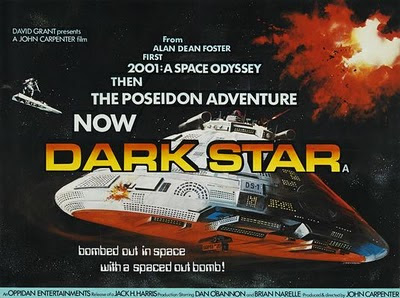
I saw this years and years ago and remembered it as being goofy and fun. Upon rewatching, it was goofy and confusing. While there are some priceless bits—the 2001-satirizing existentialist conversations trying to convince the cheerful bomb not to blow up, the beach ball alien, having the crew of the spaceship being a bunch of devil-may-care bearded longhairs—trying to listen to the poorly-recorded sound to follow what was going on gave me a headache, so I ended up self-medicating and getting nicely buzzed (strictly legal!) for about the second half of the movie, improving the experience greatly.
This leads to a very important point, that I would like to make as a Movies By Bowes ™ public service announcement: only watch Dark Star if you're high. It thus joins the following restricted list (as in, blaze first at all costs):
Head
Buckaroo Banzai
The Room
Barbarella
Roland Emmerich's entire career (Expert Level)
An Education (2009) dir. Lone Scherfig
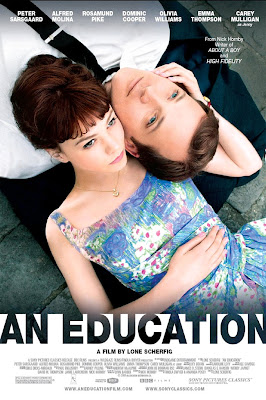
Watching this basically on a double feature with Dark Star was an interesting experience, and probably made me like this a whole lot more in a weird way. An Education tells the story of Jenny Millar (Carey Mulligan) a smart, intellectually and culturally ambitious 16 year old in early 60s England who's being pressured by her dad (Alfred Molina) to ascetically pursue her studies so as to get into Oxford.
Jenny meets an extremely charming older man (Peter Sarsgaard, not only rockin a top-notch Brit accent but appearing heterosexual, impressively) who soon sweeps her off her feet and introduces her to a world of parties, and concerts, and cocktails, weekend trips to Oxford and Paris . . . and no small amount of shadiness and criminality. Peter Sarsgaard and Dominic Cooper are sort of like the Kray twins as co-written by Scott Fitzgerald and Christopher Isherwood, so they're not dangerous or anything, but Jenny still doesn't entirely approve.
Impressively (and kind of implausibly), Peter Sarsgaard also seduces Jenny's parents (not in the biblical sense, but in a “wow, our daughter's older boyfriend is awesome!” kind of way), to the point where when Jenny finds out Peter Sarsgaard is married, Alfred Molina is just as brokenhearted as she is.
Over the course of Jenny's seduction, she's drifted from her academic ambitions, growing to see devoted, severe teacher Olivia Williams (whose character I want to drink tea and hold hands with) as dead inside and headmistress Emma Thompson (who is fucking hilarious in this) as a fascistic twat. But, after she splits with Peter Sarsgaard—having dropped out of school before taking her A-levels—Jenny tries to get back on the plan, only to have Emma Thompson tell her no, and it takes Olivia Williams getting excited in an extremely British way (oh, Olivia Williams, I want to quote Coleridge to you . . . ) about getting Jenny back on the path to see that Jenny gets the titular schooling, on the literal level.
But, “an education” works on a secondary level too, to wit the kind of knowledge and life's wisdom one can't glean from books. Losing your virginity in an anticlimactic way. Learning that glamorous people are often shallow. Learning that many art collectors are in it for art's value as a commodity rather than the love. Learning that when you're a kid you should be a kid (and, in Jenny's case, appreciate the awkward boy who worships her more) rather than aspiring to be an adult (and have Rosamund Pike get excited on your behalf that you don't have to read books anymore now that you've dropped out of school).
An Education is an example of the kind of movie that's completely insufferable when Americans try it but for some reason the Brits hit all the notes just right, and although it's totally formulaic it still manages to involve the audience emotionally. Part of that, in this movie's case, is that Carey Mulligan is so unbelievably good as Jenny. Apparently she never acted before, which is astounding, and makes An Education a companion piece to Billy Elliott, which although a much better movie, also starred a novice in the lead, and is also one of those paint-by-numbers Rembrandts the Brits crank out once or twice a year.
Hopefully, Oliver Stone doesn't torpedo Carey Mulligan's career with Wall Street 2: Are You Fucking Kidding Me, because wow.

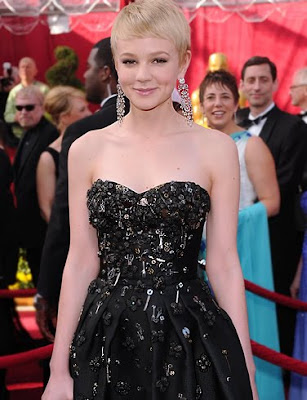
Oh, and on a random note, fuck Nick Hornby. YOU KNOW WHY, NICK.
The Informant! (2009) dir. Steven Soderbergh
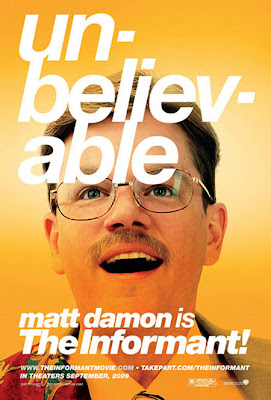
And, rounding out our trilogy of the long unwatched, we have evil white guys in suits! Hell yeah. Directed by Steven Soderbergh in full-on ironic detachment mode! Ah, shit, Steve, do you have to . . .?
Ol' Steve's a tough nut to crack. After he dropped the one-two blockbuster combo of Erin Brockovich and Traffic, he's spent the last decade alternating between Ocean's movies and seemingly deliberately off-putting experimental pictures. Some of them, like Bubble, work (because, amateur cast aside, Steve kept it simple and told a fucking story). Some of them, like The Good German, are hideous. Others, like The Girlfriend Experience, are total head-scratchers (making a movie starring Sasha Grey without any sex in it is kind of like putting Arnold in a Woody Allen movie).
The Informant! actually didn't need a ton of help from Soderbergh to be weird. The guy Matt Damon plays in it, Mark Whitacre, is fucking crazy. He spent years lying to the FBI, taping people, trying to hide his own embezzlement by ratting out his bosses, watching Tom Cruise movies, hiring and firing lawyers, and ending up getting tossed in jail for three times as long as his evil white guy bosses.
Matty Dames lets it fly as Whitacre. His narration goes way past “unreliable narrator” into a whole new category; Matty spends the whole fucking picture yammering at us about Japanese perverts, The Firm, and fictional-sounding exploits while driving the FBI's blood pressure into the 200/160 range and amusing the living shit out of his bosses.
It's a fairly interesting story, but does kind of drag a bit. The whole “corporate shenanigans as comedy” schtick was done a lot better in Barbarians at the Gate, because Steve kind of overdoes it with the jokey-jokes (just about everybody in the supporting cast is a stand-up comedian) and the Marvin Hamlisch music and the 70s-textured images—even though the movie took place in the 90s—and all.
One stroke of absolute genius, though, was casting Clancy Brown as Matty's evil white guy boss' lawyer. Clancy Brown walks into boardroom. Commands respect. Tells you what the fuck is up. Leaves. Possibility for resistance: nil. It's Clancy Brown. Now that he has white hair, he can be the lawyer, where when he was younger he was the guy with the gun, but it's good to see that badass is a growth industry.
Scott Bakula and Joel McHale are both really good as the Feds Matty Dames drives nuts, even if they don't get much to do other than reaction shots like “is this motherfucker serious?” about the increasingly bizarre shit Matty pulls on them. And the woman who played Clooney's sister in Up in the Air is really good as Matty's wife.
You know, as insignificant a thing as it actually is, there really is a sense of accomplishment about finally getting through those damn Netflix that have been sitting around since May. It'd be so much easier to sit around watching movies by myself if I didn't lead such an interesting life . . . grumble grumble . . .
—there are pretty girls to talk to, movies of my own to produce (details forthcoming), theater to see. With all this (and I'm not complaining, except about the fantasy baseball) I've been falling a bit behind on those little red envelopes. These things happen, since even at the best of times the shit on my queue tends to be the kind of thing I've been “meaning to see.” Things I really want to see I see. There isn't all this fucking hesitation that crops up when I'm watching an Oscar also-ran, or something I saw when I was high years and years ago, or some overtly “experimental” picture by a talented yet mercurial and aloof auteur.
But there comes a time when even the most neurotic among us have to man up and deal with our eclectic taste in cinema and get those fuckin' Netflix sent back. Because erudite, profane crankiness loves company, I share the experience with you:
Dark Star (1974) dir. John Carpenter

I saw this years and years ago and remembered it as being goofy and fun. Upon rewatching, it was goofy and confusing. While there are some priceless bits—the 2001-satirizing existentialist conversations trying to convince the cheerful bomb not to blow up, the beach ball alien, having the crew of the spaceship being a bunch of devil-may-care bearded longhairs—trying to listen to the poorly-recorded sound to follow what was going on gave me a headache, so I ended up self-medicating and getting nicely buzzed (strictly legal!) for about the second half of the movie, improving the experience greatly.
This leads to a very important point, that I would like to make as a Movies By Bowes ™ public service announcement: only watch Dark Star if you're high. It thus joins the following restricted list (as in, blaze first at all costs):
Head
Buckaroo Banzai
The Room
Barbarella
Roland Emmerich's entire career (Expert Level)
An Education (2009) dir. Lone Scherfig

Watching this basically on a double feature with Dark Star was an interesting experience, and probably made me like this a whole lot more in a weird way. An Education tells the story of Jenny Millar (Carey Mulligan) a smart, intellectually and culturally ambitious 16 year old in early 60s England who's being pressured by her dad (Alfred Molina) to ascetically pursue her studies so as to get into Oxford.
Jenny meets an extremely charming older man (Peter Sarsgaard, not only rockin a top-notch Brit accent but appearing heterosexual, impressively) who soon sweeps her off her feet and introduces her to a world of parties, and concerts, and cocktails, weekend trips to Oxford and Paris . . . and no small amount of shadiness and criminality. Peter Sarsgaard and Dominic Cooper are sort of like the Kray twins as co-written by Scott Fitzgerald and Christopher Isherwood, so they're not dangerous or anything, but Jenny still doesn't entirely approve.
Impressively (and kind of implausibly), Peter Sarsgaard also seduces Jenny's parents (not in the biblical sense, but in a “wow, our daughter's older boyfriend is awesome!” kind of way), to the point where when Jenny finds out Peter Sarsgaard is married, Alfred Molina is just as brokenhearted as she is.
Over the course of Jenny's seduction, she's drifted from her academic ambitions, growing to see devoted, severe teacher Olivia Williams (whose character I want to drink tea and hold hands with) as dead inside and headmistress Emma Thompson (who is fucking hilarious in this) as a fascistic twat. But, after she splits with Peter Sarsgaard—having dropped out of school before taking her A-levels—Jenny tries to get back on the plan, only to have Emma Thompson tell her no, and it takes Olivia Williams getting excited in an extremely British way (oh, Olivia Williams, I want to quote Coleridge to you . . . ) about getting Jenny back on the path to see that Jenny gets the titular schooling, on the literal level.
But, “an education” works on a secondary level too, to wit the kind of knowledge and life's wisdom one can't glean from books. Losing your virginity in an anticlimactic way. Learning that glamorous people are often shallow. Learning that many art collectors are in it for art's value as a commodity rather than the love. Learning that when you're a kid you should be a kid (and, in Jenny's case, appreciate the awkward boy who worships her more) rather than aspiring to be an adult (and have Rosamund Pike get excited on your behalf that you don't have to read books anymore now that you've dropped out of school).
An Education is an example of the kind of movie that's completely insufferable when Americans try it but for some reason the Brits hit all the notes just right, and although it's totally formulaic it still manages to involve the audience emotionally. Part of that, in this movie's case, is that Carey Mulligan is so unbelievably good as Jenny. Apparently she never acted before, which is astounding, and makes An Education a companion piece to Billy Elliott, which although a much better movie, also starred a novice in the lead, and is also one of those paint-by-numbers Rembrandts the Brits crank out once or twice a year.
Hopefully, Oliver Stone doesn't torpedo Carey Mulligan's career with Wall Street 2: Are You Fucking Kidding Me, because wow.


Oh, and on a random note, fuck Nick Hornby. YOU KNOW WHY, NICK.
The Informant! (2009) dir. Steven Soderbergh

“Four guys in suits meeting in the middle of the day? That's not a business meeting, it's a crime scene!”
—Tony “Buster Bluth” Hale
And, rounding out our trilogy of the long unwatched, we have evil white guys in suits! Hell yeah. Directed by Steven Soderbergh in full-on ironic detachment mode! Ah, shit, Steve, do you have to . . .?
Ol' Steve's a tough nut to crack. After he dropped the one-two blockbuster combo of Erin Brockovich and Traffic, he's spent the last decade alternating between Ocean's movies and seemingly deliberately off-putting experimental pictures. Some of them, like Bubble, work (because, amateur cast aside, Steve kept it simple and told a fucking story). Some of them, like The Good German, are hideous. Others, like The Girlfriend Experience, are total head-scratchers (making a movie starring Sasha Grey without any sex in it is kind of like putting Arnold in a Woody Allen movie).
The Informant! actually didn't need a ton of help from Soderbergh to be weird. The guy Matt Damon plays in it, Mark Whitacre, is fucking crazy. He spent years lying to the FBI, taping people, trying to hide his own embezzlement by ratting out his bosses, watching Tom Cruise movies, hiring and firing lawyers, and ending up getting tossed in jail for three times as long as his evil white guy bosses.
Matty Dames lets it fly as Whitacre. His narration goes way past “unreliable narrator” into a whole new category; Matty spends the whole fucking picture yammering at us about Japanese perverts, The Firm, and fictional-sounding exploits while driving the FBI's blood pressure into the 200/160 range and amusing the living shit out of his bosses.
It's a fairly interesting story, but does kind of drag a bit. The whole “corporate shenanigans as comedy” schtick was done a lot better in Barbarians at the Gate, because Steve kind of overdoes it with the jokey-jokes (just about everybody in the supporting cast is a stand-up comedian) and the Marvin Hamlisch music and the 70s-textured images—even though the movie took place in the 90s—and all.
One stroke of absolute genius, though, was casting Clancy Brown as Matty's evil white guy boss' lawyer. Clancy Brown walks into boardroom. Commands respect. Tells you what the fuck is up. Leaves. Possibility for resistance: nil. It's Clancy Brown. Now that he has white hair, he can be the lawyer, where when he was younger he was the guy with the gun, but it's good to see that badass is a growth industry.
Scott Bakula and Joel McHale are both really good as the Feds Matty Dames drives nuts, even if they don't get much to do other than reaction shots like “is this motherfucker serious?” about the increasingly bizarre shit Matty pulls on them. And the woman who played Clooney's sister in Up in the Air is really good as Matty's wife.
You know, as insignificant a thing as it actually is, there really is a sense of accomplishment about finally getting through those damn Netflix that have been sitting around since May. It'd be so much easier to sit around watching movies by myself if I didn't lead such an interesting life . . . grumble grumble . . .
Subscribe to:
Posts (Atom)