Due in large part to books like
Easy Riders, Raging Bulls, the 70s have become folklore to a certain brand of movie nerd. The decade that saw the emergence, prime, and/or best work of some of the most revered directors of all time—Altman, Coppola, Spielberg, Scorsese, et al—was largely a product of economic troubles for the studios in the 60s, that led to a desperation on the part of executives, as well as a heavy influence by the 60s counterculture and the influence of European movies.
Basically, what all this means is that suddenly, movies were different. Restrictions on cursing and nudity were removed (and what would we do without Jack Nicholson in
The Last Detail, hollering “I
am the motherfucking shore patrol motherfucker?” Or the sudden and frequent preponderance of bare boobies? Yes, I
know, we'd live, but still.) Unwritten restrictions were also lifted, like the whole “you need to have a happy ending” thing, the necessity of being reverent to institutions like the government and the church, and so forth. And with this new freedom, for a brief time before the studio power structure regained control, some strange and beautiful cinema was wrought.
There's something really special about the American cinema of the 1970s, just like France in the early 60s, Germany in the 20s, Hong Kong in the 90s. Sometimes societal influences, a bunch of good directors, and some good luck all align and the movies just fucking rock. I have a handful of personal favorites from the “Hollywood New Wave,” pictures like
Godfathers
I & II,
Annie Hall,
Mean Streets,
The French Connection,
The Last Detail,
The Conversation,
MASH,
Taxi Driver. Yes, that's a big handful. But like I said, there were a lot of good fuckin' movies.
One, though, stands out as my personal favorite. I would hesitate to call it the best American movie of the decade; it certainly is one of the best, but the competition is so badass that singling out one movie is nearly impossible. I do, however, enjoy it more than all the rest. Ladies and gentlemen, I give you
Network.
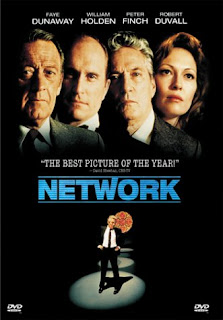
When it was released in 1976, people were like, “what the fuck . . .?” Screenwriter Paddy Chayefsky concocted what, at the time, was a very heightened satire of the television industry, wherein a last-place network resorts to absurd stunts like having the network's parent corporation directly dictate the content of the news broadcasts, putting a messianic, possibly insane “prophet” on the air and not bleeping him when he curses, and producing a reality show about a group of political terrorists. The enduring—and increasing—appeal of
Network over time is that a modern viewer, accustomed to corporate-friendly-to-a-fault news programming, TV shows occasionally being permitted the use of the word “shit” and reality shows that follow around far more disgusting people (Snooki, Heidi Montag, Jon Gosselin . . .) than any terrorist, watches it and goes, “fuck, Paddy Chayefsky called this shit before I was
born!” What once was antic craziness now seems, if anything, understated.
The opening narration informs us that
Network is the story of Howard Beale (Peter Finch), a veteran news anchorman who has slid into alcoholism and depression. His ratings fall to the point where he gets fired effective in two weeks, and William Holden, his boss and oldest friend, takes him out to go get fucked up and tell stories about the old days. At a particularly candid and shitfaced moment, Peter Finch tells William Holden he's going to blow his brains out on the air on his last broadcast. William Holden thinks he's kidding and cynically riffs on the idea, coming up with a TV show called
The Death Hour that will “put fuckin' Disney right off the air.” (Note, the indestructibility of the Disney Corporation is one of the only failures by Chayefsky to see into the future)
But, lo and behold, Peter Finch goes on the air and says he's going to blow his brains out on his last broadcast, predicting, “It should get a hell of a rating. 50 share, easy.” Everybody in the booth loses their shit, and they end up scrambling to physically remove Peter Finch from the set and a whole bunch of cursing goes out live.
Corporate network shark Robert Duvall, after “over 900 fucking phone calls complaining about foul language,” wants to fire Peter Finch immediately, but is ultimately talked down to letting him back on the air to give one last farewell address.
Meanwhile, Robert Duvall announces that due to excessive annual shortfalls, the network's corporate parent is going to supervise the news division. William Holden gets fucking pissed off—naturally—and goes to his boss, who tells him they'll talk about it later. William Holden sulks. Then, when Peter Finch goes on the air for his last broadcast and explains his announced intent to commit suicide thusly: “I just got tired of the bullshit.” The director goes to cut him off, but William Holden leaves him on, and he discourses on the word bullshit for a while, leading to panicked phone calls from people, one of which William Holden rebuffs with the greatest line ever:
“He's saying that life is bullshit, and it is. So what are you screaming about?”
Due to some outside-the-box thinking by Faye Dunaway, neither William Holden or Peter Finch gets fired. Faye Dunaway is a programming executive, frustrated with the boilerplate bullshit writers keep bringing her, so she gets the idea that with some bells and whistles, the news show could be a hit. At the same time, she's developing a show about some terrorists, whose contact (Marlene Warfield) she meets like this:
Faye Dunaway: Hi. I'm Diana Christensen, a racist lackey of the imperialist ruling circles.
Marlene Warfield: I'm Laureen Hobbs, a badass commie nigger.
Faye Dunaway: Sounds like the basis of a firm friendship.
Faye Dunaway goes on to explain her intent:
“I'm interested in doing a weekly dramatic series based on the Ecumenical Liberation Army. The way I see the series is: Each week we open with an authentic act of political terrorism taken on the spot, in the actual moment. Then we go to the drama behind the opening film footage. That's your job, Ms. Hobbs. You've got to get the Ecumenicals to bring in that film footage for us. The network can't deal with them directly; they are, after all, wanted criminals.”
Faye Dunaway and William Holden begin an affair, but Peter Finch becomes a problem. His behavior has been growing increasingly erratic since the beginning of the movie—culminating in apparent hallucinations and fainting spells. William Holden wants to pull Peter Finch off the air for the sake of his mental health, but Peter Finch's ratings are good enough that Robert Duvall fires William Holden. Fay Dunaway simultaneously ends the affair. Left on the air, Peter Finch continues to deteriorate until one day, he wanders in out of the rain talking to himself.
Security guard: Good afternoon, Mr. Beale!
Peter Finch: I must make my witness!
Security guard: Sure thing, Mr. Beale!
He then proceeds to go straight into the studio, only getting in his chair, still drenched from the rain, seconds before he's supposed to go on the air. Once the cameras are rolling, without preamble, he launches into the movie's most famous speech:
"I don't have to tell you things are bad. Everybody knows things are bad. It's a depression. Everybody's out of work or scared of losing their job. The dollar buys a nickel's work, banks are going bust, shopkeepers keep a gun under the counter. Punks are running wild in the street and there's nobody anywhere who seems to know what to do, and there's no end to it. We know the air is unfit to breathe and our food is unfit to eat, and we sit watching our TV's while some local newscaster tells us that today we had fifteen homicides and sixty-three violent crimes, as if that's the way it's supposed to be. We know things are bad - worse than bad. They're crazy. It's like everything everywhere is going crazy, so we don't go out anymore. We sit in the house, and slowly the world we are living in is getting smaller, and all we say is, 'Please, at least leave us alone in our living rooms. Let me have my toaster and my TV and my steel-belted radials and I won't say anything. Just leave us alone.' Well, I'm not gonna leave you alone. I want you to get mad! I don't want you to protest. I don't want you to riot - I don't want you to write to your congressman because I wouldn't know what to tell you to write. I don't know what to do about the depression and the inflation and the Russians and the crime in the street. All I know is that first you've got to get mad. You've got to say, 'I'm a HUMAN BEING, goddamn it! My life has VALUE!' So I want you to get up now. I want all of you to get up out of your chairs. I want you to get up right now and go to the window. Open it, and stick your head out, and yell, 'I'M AS MAD AS HELL, AND I'M NOT GOING TO TAKE THIS ANYMORE!' I want you to get up right now, sit up, go to your windows, open them and stick your head out and yell - 'I'm as mad as hell and I'm not going to take this anymore!' Things have got to change. But first, you've gotta get mad!... You've got to say, 'I'm as mad as hell, and I'm not going to take this anymore!' Then we'll figure out what to do about the depression and the inflation and the oil crisis. But first get up out of your chairs, open the window, stick your head out, and yell, and say it: "I'M AS MAD AS HELL, AND I'M NOT GOING TO TAKE THIS ANYMORE!”
And with that, icon status is ensured (for both Howard Beale the character and Peter Finch the actor). With Peter Finch leading them in, the terrorists' show becomes a massive hit as well, although Faye Dunaway complains of the legal troubles. After William Holden's old boss' funeral—and the inevitability of Robert Duvall exploiting this death to expand his own power at the network, William Holden and Faye Dunaway rekindle their affair. William Holden's wife, is predictably unamused.
Here we must hail one of the most brilliant supporting performances of all time. Beatrice Straight is in basically one scene (earlier she wakes William Holden up to tell him “Howard's gone”; that's the only other line she has in the movie, I think) and won the Oscar for Best Supporting Actress. Why, you ask? Was it one of those lifetime achievement deals where they just threw her one for past work? Weak category? Nope, she's just goddamn incredible, and Paddy Chayefsky gives her some
serious text. This is her after William Holden admits, under duress, that he's in love with Faye Dunaway:
“Get out, go anywhere you want, go to a hotel, go live with her, and don't come back. Because, after 25 years of building a home and raising a family and all the senseless pain that we have inflicted on each other, I'm damned if I'm going to stand here and have you tell me you're in love with somebody else. Because this isn't a convention weekend with your secretary, is it? Or - or some broad that you picked up after three belts of booze. This is your great winter romance, isn't it? Your last roar of passion before you settle into your emeritus years. Is that what's left for me? Is that my share? She gets the winter passion, and I get the dotage? What am I supposed to do? Am I supposed to sit at home knitting and purling while you slink back like some penitent drunk? I'm your wife, damn it. And, if you can't work up a winter passion for me, the least I require is respect and allegiance. I hurt. Don't you understand that? I hurt badly.”
The way she sends William Holden off is heartbreaking. Even though, as she states above, she's absolutely devastated by his throwing her over for Faye Dunaway and her Martian drag queen cheekbones, she still cares for him enough to wish him well and sadly tell him that Faye Dunaway is really going to work his ass over (though a lot classier than that).
This is the point in the movie where shit starts to go south for everybody. Peter Finch shoots his mouth off about some deal with the Arabs to buy the network's corporate parent, which causes Robert Duvall's boss to call him up and tire-iron his nuts over the phone. Peter Finch is summoned to have a word with The Big Guy. Aptly enough, the big guy is played by Ned Beatty, who is fucking
sick in this movie. Yeah, a large part of it is having an awesome script, but Ned Beatty kills it in this scene. Not only that, but holy
shit is it uncomfortable to pay too close attention to this text in the modern political/economic climate:
Ned Beatty: [bellowing] You have meddled with the primal forces of nature, Mr. Beale, and I won't have it! Is that clear? You think you've merely stopped a business deal. That is not the case! The Arabs have taken billions of dollars out of this country, and now they must put it back! It is ebb and flow, tidal gravity! It is ecological balance! You are an old man who thinks in terms of nations and peoples. There are no nations. There are no peoples. There are no Russians. There are no Arabs. There are no third worlds. There is no West. There is only one holistic system of systems, one vast and immane, interwoven, interacting, multivariate, multinational dominion of dollars. Petro-dollars, electro-dollars, multi-dollars, reichmarks, rins, rubles, pounds, and shekels. It is the international system of currency which determines the totality of life on this planet. That is the natural order of things today. That is the atomic and subatomic and galactic structure of things today! And YOU have meddled with the primal forces of nature, and YOU...WILL...ATONE! [calmly] Am I getting through to you, Mr. Beale? You get up on your little twenty-one inch screen and howl about America and democracy. There is no America. There is no democracy. There is only IBM, and ITT, and AT&T, and DuPont, Dow, Union Carbide, and Exxon. Those are the nations of the world today. What do you think the Russians talk about in their councils of state, Karl Marx? They get out their linear programming charts, statistical decision theories, minimax solutions, and compute the price-cost probabilities of their transactions and investments, just like we do. We no longer live in a world of nations and ideologies, Mr. Beale. The world is a college of corporations, inexorably determined by the immutable bylaws of business. The world is a business, Mr. Beale. It has been since man crawled out of the slime. And our children will live, Mr. Beale, to see that . . . perfect world . . . in which there's no war or famine, oppression or brutality. One vast and ecumenical holding company, for whom all men will work to serve a common profit, in which all men will hold a share of stock. All necessities provided, all anxieties tranquilized, all boredom amused. And I have chosen you, Mr. Beale, to preach this evangel.
Peter Finch: Why me?
Ned Beatty: Because you're on television, dummy. Sixty million people watch you every night of the week, Monday through Friday.
Peter Finch: I have seen the face of God.
Ned Beatty: You just might be right, Mr. Beale.
So Peter Finch starts regurgitating Ned Beatty's “you're fucked any way you look at it, so you might as well just give up and let the worldwide capitalist infrastructure make a buck off you” line and his ratings start to plummet. As his ratings plummet, the terrorists start worrying about their profit margin:
Laureen Hobbs (apparently forgetting her Marxist origins): Don't fuck with my distribution costs! I'm making a lousy two-fifteen per segment and I'm already deficiting twenty-five grand a week with Metro! I'm paying William Morris ten percent off the top, and I'm giving this turkey ten thou per segment, and another five to this fruitcake! And Helen, don't start no shit about a piece again! I'm paying Metro twenty-thousand for all foreign and Canadian distribution, and that's after recoupment! The Communist Party's not gonna see a nickel of this goddamn show until we go into syndication!
Helen Miggs: C'mon Laureen. The party's in for seventy-five hundred a week of the production expenses.
Laureen Hobbs: I'm not giving this pseudoinsurrectionary sedentarian a piece of my show! I'm not giving him script approval, and I sure as shit ain't gotten him into my distribution charges!
Mary Ann Gifford (the heiress who, like Patty Hearst, has become a hardcore terrorist): You fucking fascist! Did you see the film we made of the San Marino jail breakout, demonstrating the rising up of the seminal prisoner class infrastructure?
Laureen Hobbs: You can blow the seminal prisoner class infrastructure out your ass! I'm not knockin' down my goddamn distribution charges!
Great Ahmed Kahn (the gigantic black head terrorist): [fires off his gun through the ceiling; the network suits fall out of their chairs] Man, give her the fucking overhead clause! Let's get back to page twenty-two, number 5, small 'a'. Subsidiary rights.
Then, after that, when the ratings still don't improve, Laureen Hobbs complains to Faye Dunaway:
“He's plague, he's smallpox, he's typhoid. I don't want to follow his goddamn show. I want out of that 8 o'clock spot. I've got enough troubles without Howard Beale as a lead-in. You guys scheduled me up against Tony Orlando and Dawn, NBC's got Little House on the Prairie, ABC's got . . . The Bionic Woman! You've gotta do something. You've gotta do something about Howard Beale. Get him off the air. Get him off. Do something. DO ANYTHING.”
In the midst of all this, William Holden tires of Faye Dunaway's bloodless workaholism, gives her a lecture about her inability to live real life due to her total immersion in television, and goes back to his wife.
Rather than mourn the end of the affair, Faye Dunaway is forced to deal with a unique problem: in spite of Peter Finch's ratings freefall and permanent departure from the center of the zeitgeist, Ned Beatty insists that he stay on the air to spread the gospel of “go fuck yourself until it's the system's turn to fuck you.” Robert Duvall finds this vexing, since to keep Peter Finch on the air is commercial suicide. From this quandary, Robert Duvall comes to the solution of having Peter Finch assassinated. Oh, yeah, not character assassination or any of that pussy shit. Robert Duvall literally wants to have Peter Finch
whacked. There's a bit of hand-wringing about the morality of homicide before:
Robert Duvall: Well, the issue is: Shall we kill Howard Beale, or not? I'd like to get some more opinions on that.
Faye Dunaway: I don't see we have any options, Frank. Let's kill the son-of-a-bitch.
Faye Dunaway gets the Great Ahmed Kahn to gun Peter Finch down in the studio, as crossover programming for the terrorists' TV show. And so it is done, leaving the narrator to remark: “This has been the story of Howard Beale . . . the first
known instance of a man who was killed for having lousy ratings.” (Italics mine, I just love the implication that there may have been other times)
Among other things,
Network is, next to
Casablanca, the best way to get auteur theory advocates to turn purple. Sidney Lumet is not the artistic driving force behind this movie, Paddy Chayefsky is, and most of Sidney Lumet's job directing this movie consisted of staying the hell out of the script's way and just pointing the camera at the actors. About the actors, every single one of them down to the tiniest part is goddamn brilliant. Peter Finch's work—for which he receieved a posthumous Oscar—is justifiably legendary, but the entire cast is on his same level. Faye Dunaway, who also won an Oscar, is terrific as well, although she has to stop to breathe often enough that you can tell her theater background is a little wanting (yeah, that was catty, but what has two thumbs and doesn't give a fuck? This guyyyyyyy . . .) William Holden is almost as good in this as he is in
Stalag 17, but really, that's like saying the White Album is almost as good as
Revolver. Robert Duvall kills it. Ned Beatty not only kills it, he also may give the most fun to imitate performance ever (“YOUUUU HAVE MEDDLED WITH THE PRIMAL FORCES OF NAAAATURE, MISTERRR BEALE!!!!!”) Ah, man, I could go on all day. Fuck it, the
grips on this movie were so fucking good I want to give them a special roll of duct tape with a label on the inside saying “Good job!” The catering guys probably made the best sandwiches in the history of cinema.
Mainly,
Network endures to this day solely for Peter Finch's “I'm as mad as hell and I'm not going to take this anymore” business (which George Clooney paraphrases hilariously in
Out of Sight: “I'm mad as hell, and I ain't gonna take any more o' yer shit!”) and for just about every jerkoff, retard, and fuckface on the Fox News payroll comparing themselves to Howard Beale. Glenn Beck does this all the time, forgetting that being crazy isn't all there is to being Howard Beale. You have to tell the truth and get people to resist the evils of their age, rather than implicitly advocate the assassination of the one guy in the country who's fucking doing anything about those evils.
Even if Glenn Beck was smart enough to understand who Howard Beale actually
was, why would he want to compare himself to an alcoholic failure who only attained fame when he began hallucinating a God who apparently looked like Ned Beatty? We may never know, even if we do know that just about every ill in modern society has been caused by people not paying close enough attention while watching
Network. Well. That
may be an exaggeration. But not as much of one as you might think.


